
Tip
Haskell bindings supported!: Bindings documentaton
Note
Fixing documentation to latest changes. If you have any questions setting up P2PRC either create an issue or send me an email (me AT akilan dot io). Currently HEAD is always intended to stay on a working state. It is recommended to always use HEAD in your go.mod file.



This project aims to simplify self-hosting servers and streamline the creation of distributed systems. The primary focus is to enable users to design custom peer-to-peer networks for distributed computing, offering full flexibility and control while abstracting away the complexities of networking.
Key Features
Simplified Self-Hosting Empower users to easily host nodes, whether on personal computers behind NAT, custom hardware, or cloud-based infrastructure.
Custom Peer-to-Peer Networks
Build a decentralised network tailored to user requirements, enabling distributed task execution without the need for in-depth networking knowledge.
Heterogeneous Node Support
Harness a diverse array of nodes—from personal computers to specialised hardware—seamlessly integrated into a global node list.
Abstracted Networking Layer
Networking details are completely abstracted, enabling users to focus on developing bespoke task orchestration systems. No more manual configuration of IPs, ports, or connection logic.
Flexible Task Distribution
Users acting as clients retain full control over how tasks are batched and assigned to nodes, creating endless possibilities for optimising performance based on specific use cases.
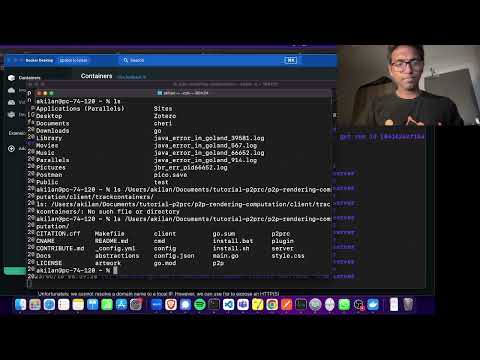
Latest tutorial
Introduction
This project aims to create a peer to peer (p2p) network, where a user can use the p2p network to act as a client (i.e sending tasks) or the server (i.e executing the tasks). A prototype application will be developed, which comes bundled with a p2p module and possible to execute docker containers or virtual environments across selected nodes.
Objectives
- Background review on peer to peer network, virtual environments, decentralized rendering tools and tools to batch any sort of tasks.
- Creating p2p network
- Server to create a containerised environment
- The client node to run tasks on Server containerised node
Extend your application with P2PRC
package main

import (
	"fmt"
	"github.com/Akilan1999/p2p-rendering-computation/abstractions"
)

func main() {
	_, err := abstractions.Init(nil)
	if err != nil {
		fmt.Println(err)
		return
	}

	// start p2prc
	_, err = abstractions.Start()
	if err != nil {
		fmt.Println(err)
		return
	}

	// Run server till termination
	for {

	}
}
Find out more
As we are working on the open source project p2prc (i.e p2p network designed for computation).If you are interested in participating as a contributor
or just providing feedback on new features to build or even just curious about new features added to the project. We have decided to create a discord group.
